Swiss Format Explained
Steel City Backgammon
Swiss format has been used in chess for a long time. It is now becoming very popular in the backgammon world also. The Chicago Open, the Cherry Blossom Tournament and several other ABT tournaments use it for their main tournaments.
What follows are the rules for applying Swiss format in a simple, understandable way. These are the rules of Swiss tournaments hosted by Steel City Backgammon. You may play in other Swiss format tournaments that are slightly different, especially the tie-break rules.
The canonical reference for Swiss format is FIDE [1], a chess federation, but its rules are more formal than necessary for club tournaments.
In Brief
Swiss is akin to round robin, where everyone plays everyone. The tournament is played in rounds, with the same number of matches played in each round.
To begin, players face off against other players with a random draw. In subsequent rounds, players face players with roughly the same record. Players will not play the same player twice except in rare cases. Play continues until there is a clear winner, or until a set number of rounds is played.
Why Swiss?
- It’s more fun! You play more matches against more different players.
- You play players with similar skill (based on record) as long as possible.
- No waiting around for a match after 1 loss. With Swiss, you play as soon as a new round is ready.
- Even if you are mathematically eliminated from cashing, you can keep playing! The system will keep pairing you until the end of the tournament, or you drop out, whichever comes first.
Why Not Swiss?
It can run a long time, if the match length is long, and the agreed-upon number of rounds is high. You’ll see this format used for multi-day tournaments, like ABT that extend over a weekend.
How does it work?
- The first round pairs players with a random draw
- A BYE will be assigned randomly if there is an odd number of players
- A player receiving a BYE is awarded a win for the round
- All players’ records (W-L) are tracked
- When a new round begins, the system pairs players randomly, subject to 2 important rules:
- Pair players with the same record. If not possible, for example with an odd number of players, pair to the next lower record group, never to a higher group
- Pair players who have not played each other before. If not possible (can happen in later rounds) pair players in the next lower record group. If still not possible, some players will need to play a rematch
- Continue for a set number of rounds (or until a clear final ranking is established)
- Any player can drop out (although we hope you don’t!) and the system will handle it.
- After all rounds have been played, players are ordered according to the tie-break rules.
- The winner and placers are determined by the order, where the first player is the winner, next player is second place, etc.
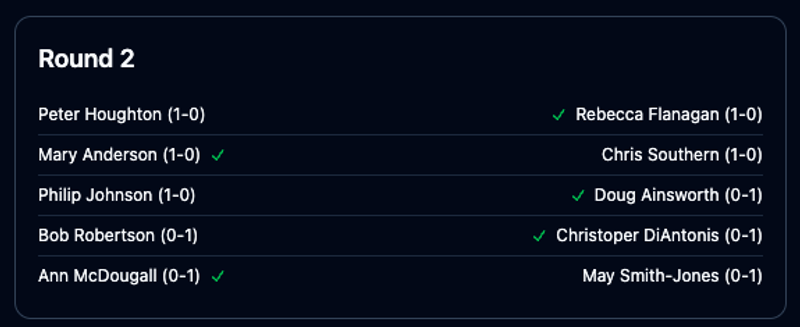
Below is a sample round with pairings and match winners recorded. Notice how the 1-0 players played each other and the 0-1 players played each other, with the exception of Phillip and Doug, who were paired because the system ran out of 1-0 players and paired down.
Tie-Break Rules
At the end of the tournament (after all rounds have been played), the players are sorted according to the following algorithm. “Wins” in what follows is the same as “record”. It is the sum of a player’s wins.
The following rules cannot be applied until all rounds have been played.
- Wins - how many matches did you win?
- Players tied after (1) are sorted by Buchholz
- Players tied after (2) are sorted by Sonneborn-Berger
- Players tied after (3) - this is rare - are sorted by random draw
Buchholz
Standard Swiss tie-break system used in chess for years. [2]
It is the sum of all your opponents' wins. It rewards playing against strong opponents - if everyone you faced did well, your Buchholz score is high. It's a measure of the strength of your schedule.
Sonneborn-Berger
Standard Swiss tie-break system used in chess for years. [3]
It is the sum of the wins of only the opponents you beat. It rewards winning against stronger opponents. A win against someone who finished 3-1 counts more than a win against someone who finished 1-3.
Here’s an example of a finished tournament with tie-breaks applied:

In this example, Mary has the most wins (4) so she sorts first, followed by two players who each have 3 wins, settled by tie-break. Notice that Doug has a higher Buchholz score than Rebecca, so he sorts higher. Within the 2-2 players, there is an example of a tied Buchholz score (Phillip and Ann) and this is settled by using the Sonneborn-Berger score. (3 vs 1)